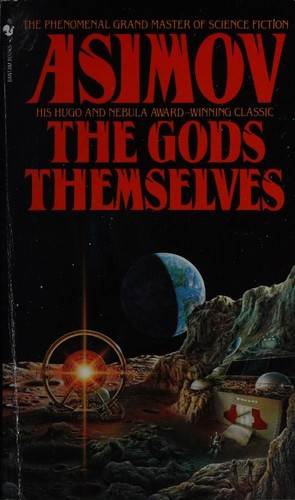
The title comes from a longer line, against stupidity the gods themselves contend in vain, and the book is structured in three sections that share a premise more than a cast: an electron pump linking our universe to a parallel one where the laws of physics run differently, offering seemingly free energy at a cost nobody in the first section wants to look at too closely.
The middle section is the one people talk about, and rightly so. It follows a trio of para-Men on the other side of the pump, beings that exist as three sexed forms with a biology and a mode of reproduction unlike anything I’ve read elsewhere in the genre, and Asimov commits to it fully rather than treating it as a gimmick. Their sections carry real emotional weight, which surprised me given how much of Asimov’s other work I’ve found more interested in ideas than in people. The first section, following the human scientist Hallam and the mediocrity that somehow gets him credited with discovering the pump, is sharper on institutional pettiness and scientific ego than I expected, though it’s also the section that reads most clearly as a product of its 1972 publication date, particularly in how it handles its one notable woman character.
The third section, on the moon, felt like the weakest of the three to me, competent but less urgent than what came before it, more interested in wrapping up plot threads than in doing anything the first two hadn’t already done better. I’ve seen other readers call this Asimov’s best novel specifically because it’s the one where he seems most invested in character rather than concept, and I think that’s fair for the middle third at least. Four stars overall, mostly on the strength of the para-Men, who I’m still thinking about weeks later in a way I don’t usually with Asimov’s other work.